 Coral
Coral Coral token utility links CORL payments to premium DeFAI services
Updated -
Coral token utility gives CORL a payment role in Coral Finance’s premium services, including AI analytics and automated strategy tools. DeFAI combines decentralized finance with artificial intelligence. The same token supports staking-based governance and incentives for ecosystem contributions. Premium payments fund service access, while staking duration influences governance voting power. Liquidity and community rewards follow the activity receiving the incentive, so owning CORL alone does not qualify a holder for every reward program.
CORL payments for premium access
Premium access uses CORL when the selected service requires payment in the token. The service’s charging terms determine the required payment.
Payment and spending permissions
CORL payments involve a token amount and a recipient. Its ERC-20-compatible contract supports direct transfers and allowances for another address to spend tokens. A finite allowance authorizes spending up to its limit, while a direct transfer moves the stated amount from the sender’s balance to the recipient’s balance; granting another address spending permission does not itself make the payment. The contract treats maximum-value approvals as unlimited, so those allowances do not decrease after spending. A service can use these operations within its payment design, although the token contract alone does not define subscription periods, refunds, or a premium feature’s charge.
The purchased service
Service access belongs to the application layer. A completed token transfer establishes token movement; it does not describe which analytics features a service enables. Access means the purchased function becomes available under the service’s payment terms. Any access period or renewal charge belongs to those terms.
The platform token and point-linked corTokens
CORL as the platform token
CORL is Coral Finance’s utility and governance token on BNB Smart Chain. Its payment and voting roles apply to the platform. A premium-service charge concerns this token even when the tool analyzes or trades another asset.
corTokens as point-linked assets
corTokens represent tokenized points from participating projects. In the deposit-based route, eligible receipt assets support point accrual and minting; newly minted corTokens begin locked. Unlocking governs when those assets become usable. A corToken balance describes a point-linked position, so point conversion and unlocking rules cannot determine CORL governance weight or a premium-service charge.
Staking duration and protocol governance
Voting weight
CORL staking duration influences governance voting power. A wallet balance and a governance stake therefore describe different states. The governing staking rules determine the voting weight a participant receives. A precise multiplier or withdrawal date requires the applicable staking terms.
Decisions within Coral Finance
Protocol governance can address trading parameters and fee structures. It also covers ecosystem and liquidity incentives, strategic partnerships, and feature integrations. A governance vote concerns a protocol decision; it does not pay a service invoice. Participants exercise their voting weight through the governance process.
Analytics outputs and automated strategy actions
AI analytics supplies information, while an automated strategy uses rules to place or adjust trades. Echo Trader combines AI parameters with market signals to identify trending assets. Its interface includes asset details and trading through Coral Finance. An analysis output and a trade have separate consequences: the output describes an asset, and the trade changes a position. CORL’s premium-payment role applies when the selected service charges the token; it does not establish identical charging rules across these functions.
Smart DCA automates dollar-cost averaging. Smart DCA adjusts purchase timing and size using market conditions. The service charge pays for automation, while capital allocated to the strategy funds its purchases. Market conditions determine the prices available to those purchases, so the feature’s objectives do not establish a fixed return.
Incentives and the activity behind a reward
CORL incentives reward contributions including pool liquidity, community work, and ecosystem services. Liquidity providers receive the token for supplying capital to pre-market trading pools. Community participation can include content creation, moderation, technical development, and user acquisition. Ecosystem partners can receive CORL allocations for providing infrastructure and complementary services to address functional gaps in Coral Finance’s application layer. Referral and staking programs also use CORL as a reward instrument. Eligibility, distribution, and claimability follow the particular program; an incentive allocation does not itself establish a spendable wallet balance.
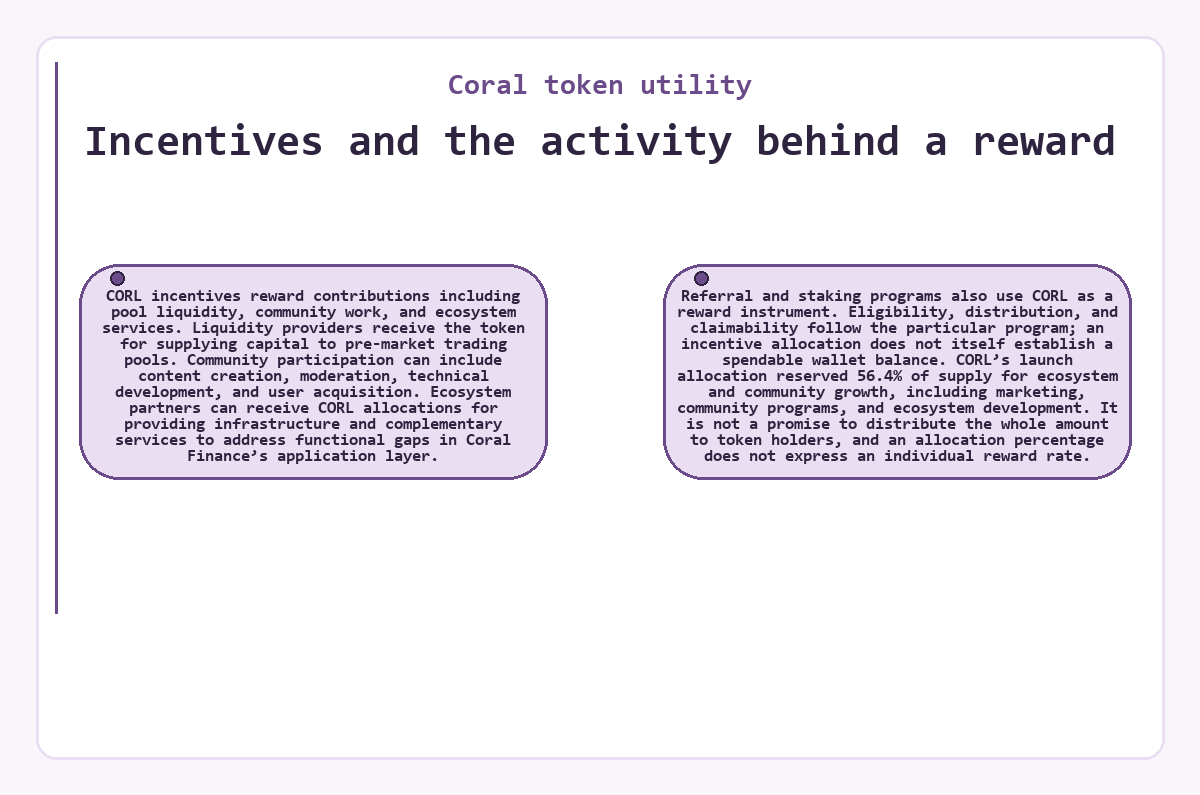
CORL’s launch allocation reserved 56.4% of supply for ecosystem and community growth, including marketing, community programs, and ecosystem development. It is not a promise to distribute the whole amount to token holders, and an allocation percentage does not express an individual reward rate.
Payment, voting, and reward participation
CORL participation can involve purchasing a function, committing tokens for a vote, or receiving rewards for a contribution.
| Participation option | CORL role | Participation requirement |
|---|---|---|
| Premium AI analytics | Service payment | A selected analytics service accepting CORL |
| Automated strategy tools | Service payment | A selected strategy service accepting CORL |
| Specialized yield opportunities | Premium access payment | A selected premium offering accepting CORL |
| Protocol governance | Staked voting token | CORL staked under the governance rules |
| Pre-market pool liquidity | Contribution reward | Capital supplied to an incentivized pool |
| Community contributions | Contribution reward | A contribution covered by an incentive program |
Initial supply and usable CORL balances
CORL’s deployment minted 1,000,000,000 tokens. The token contract records account balances separately from total supply. Reserved or vested allocations concern who controls tokens and when distribution makes them available. A figure for the whole supply does not tell a service how much a particular wallet can pay. The amount available for a payment comes from that wallet’s usable CORL balance. Protocol governance includes changes to fees and incentive allocations. A fixed issuance figure cannot supply a permanent service charge or an individual reward rate. The relevant service and program terms determine those amounts, while voting weight follows the governance staking rules.
Service access and fee-sharing rights
CORL’s payment and governance roles establish service access and participation in protocol decisions. The 2025 token announcement also outlined developing revenue-sharing models tied to platform fees and pre-market trading. Fee-sharing entitlement depends on an implemented distribution mechanism and its eligibility rules. A token payment or governance stake alone does not specify a recipient’s share of that revenue.
Coral token utility FAQ
Can CORL pay BNB Smart Chain transaction fees?
Ordinary transactions on BNB Smart Chain use BNB to pay native gas fees. CORL can have a payment role inside Coral Finance without becoming the network’s gas token. A CORL service charge and the blockchain fee concern different assets. Keeping CORL in a wallet does not itself provide the BNB used for an ordinary transaction’s fee.
Does burning CORL unlock premium tools?
CORL’s burn function destroys tokens from the caller’s balance and reduces total supply; it contains no premium-access operation. Burning and transferring tokens perform different contract actions. Any application treating a burn as a service payment would need its own access rules, so invoking the burn function alone does not establish a premium entitlement.
Do CORL rewards have a fixed cash value?
A CORL-denominated reward specifies a token quantity, not a fixed cash value. The value available through an exchange depends on the executable market price and the costs of conversion. An incentive allocation or reward amount does not set that price, so more token units and greater monetary value are different claims.
Can I reverse a CORL payment by changing its spending allowance?
Reducing a CORL spending allowance affects future authorized spending and does not undo an already completed transfer. Returning the paid CORL requires another transfer. The remaining allowance and the prior payment amount describe different states, even when they involve the same service.
Is CORL governance staking the same as securing BNB Smart Chain?
CORL governance staking concerns Coral Finance’s protocol decisions, while BNB staking supports BNB Smart Chain’s validator system. The assets and governance scopes differ. A CORL governance stake therefore does not automatically make its holder a network validator or give that holder the validator rewards associated with BNB staking.